Rethinking "invasive"
Ecological Imperialism, the Columbian Exchange, and the Unwanted Animal
Ecological Imperialism, the Columbian Exchange, and the Unwanted Animal
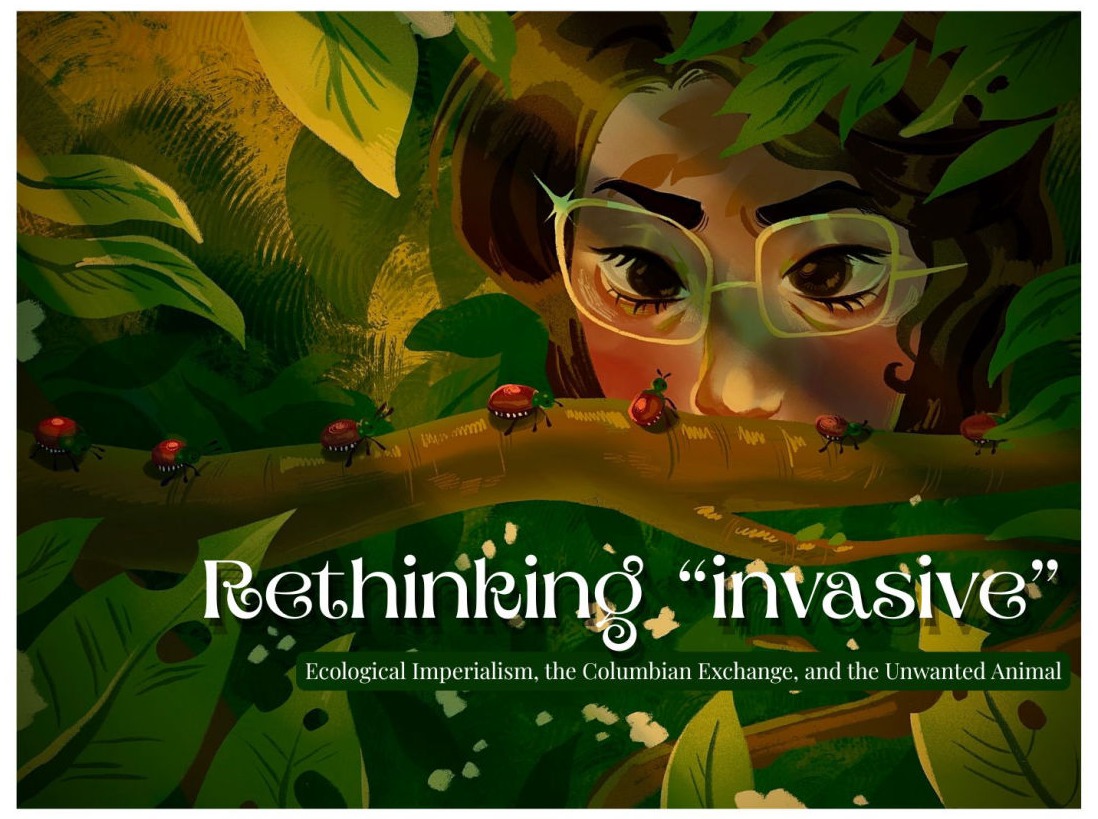
You can tell summer has settled in when blissful students are relishing their breaks, when frost-dusted ice creams are being fished out the back of freezers, and when you finally see the terrifying flash of a Japanese beetle.
Where I live, Japanese beetles are solidly non-native. Similarly to other invasive species, the name itself reminds you of its origin far across the ocean, like the Asian carp or Madagascar ragwort. I find that this category of names can provoke a defensive rise out of citizens; wherever it came from, I haven’t heard of it, so it doesn’t belong here.
But that doesn’t mean that the beetle isn’t harmless. Each year, at the peak of the hottest summer month, these bugs emerge from the ground like a horde of starving warriors. Any crops in their way, including my mother’s young fruit trees, are stripped bare. And when the beetle reappeared this year, languidly lounging on half-shredded leaves, I searched online for public opinion and what people were doing to save their own cherry trees.
I like to think of myself as at least eco-conscious – Wild Kratts and National Geographic being my first mentors – so I expected to see mobs rallied against the things. After finding the second beetle in my shirt, I couldn’t see any way that anyone could justify its existence. But to my surprise, there is a group of people who think the public’s instinctual disdain for invasive species could be connected to something deeper.
If we examine invasive species in history, we can notice one world-shattering event: the Columbian Exchange. The term refers to the biological exchange of plants, animals, and diseases between Afro-Eurasia and the Americas following Columbus’ voyages. In my history classes, teachers tended to emphasize the death and disease that decimated Indigenous populations (which is a key piece of information), but not the environmental effects of the plants and animals.
Meghann Leann Holmes, professor at Mississippi State University, offers in her 2013 thesis that invasive species aren’t biologically defined, but instead rooted in a sense of European superiority and nationalism that arose during the 1800s.
“Americans continued to grow crops and raise livestock from other countries but began to perceive plants and animals within the nation as superior to those from other areas” (Holmes 2013).
The process of fostering European species while rejecting native ones is called “ecological imperialism”, a term first coined by Alfred Crosby in his 1986 publication by the same name. In summary, it’s people trying to block “invasive species” from their own invasive ecosystem.
Moreover, Holmes continues on to counter our modern use of the word “invasive” when referring to species originating in countries anywhere aside our own.
“The words people use when they discuss plants and animals matter…calling a plant [or animal] invasive requires the perception of a static, geographically constrained environment, belied by changes in nature over time” (Homes 2013).
The misuse of the term seems to be a recurring issue. This article by Crawford Killian describes the findings of American journalist Sonia Shah’s novel, The Next Great Migration: The Beauty and Terror of Life on the Move. In it, Shah argues that plants, animals, and people naturally migrate across our globe and shouldn’t be tied to a specific place. In fact, Swedish scientist Carl Linnaeus, who first developed the Latin-based format of naming species, assumed that all animals belonged only in their place of God-given origin. So the Japanese beetle, Asian carp, or Madagascar ragwort? All unnecessary names.
“European whites thought that they, as superior humans, deserved to migrate because they could exploit other peoples’ resources better […] In effect, Europeans decided that it was OK to invade other peoples’ lands, but not OK if other people invaded them” (Killian 2020).
This sentiment connects back to the ecological imperialism I mentioned beforehand. If we really were trying to get rid of invasive species, we would’ve pushed sheep, cows, pigs, wheat, and citrus off the continent long ago. That’s what differentiates the native greater long-nosed bat and the European honeybee. They’re both endangered pollinators, but which one have you heard more of?
“Across this spectrum, a key contribution to this conversation has been to historicize invasiveness: what makes a species “invasive,” in other words, is shaped by relations of power in societies. And in turn, ‘a sizable body of research shows how examples of efforts to control introduced and invasive species often reinforced unequal gender, power, and race relations’” (Skotnes-Brown 2025).
As language like “alien”, “invasive”, or “exotic” become more common, it’s hard not to notice the connections that can be made between an invasive species and an unwanted people. American Perceptions of Immigrant and Invasive Species: Strangers on the Land by Peter Coates notes the use of language by media and associations that compares invasive species with immigrants. Especially now, it’s important to notice how an ideology sinks into all walks of life.
Make no mistake; invasive species are undeniably harmful for the environment and for human lives. And for an invasive species, the plants and animals that I mentioned have even been beneficial for all types of medicine and agriculture.
But I think that’s part of what Shah and Holmes were arguing; it doesn’t matter if a species is beneficial to people, because ultimately, nature will find its way across the ocean. “Invasive” and “native” species are not really definitive concepts, and sometimes used to make one country's entire ecosystems better than others. Instead of shielding our European plants and animals from Asian and African “threats”, we should find a way to bolster native species to be able to handle the challenge (if we even still know what classifies something as “native” anymore).
Maybe this whole time, I was trying to protect my invasive cherry trees from an invasive beetle. Maybe there is more to the Japanese beetle than meets the eye.
But for now, I think I’ll just stay inside.
Coates, Peter. 2006. American Perceptions of Immigrant and Invasive Species: Strangers on the Land. N.p.: University of California Press. https://www.jstor.org/stable/10.1525/j.ctt1pphph.
Holmes, Meghan L. 2013. “Plants And Animals As Saviors And Invaders: Changing Perspectives On Invasive Species From The Colonial Era To The 21st Century.” University of Mississippi eGrove. https://egrove.olemiss.edu/cgi/viewcontent.cgi?article=1875&context=etd.
IUCN Red List. 2015. “Greater Long-nosed Bat.” IUCN Red List. https://www.iucnredlist.org/species/11697/22126172.
Killian, Crawford. 2020. “Who Are You Calling ‘Invasive’?” The Tyee. https://thetyee.ca/Culture/2020/07/15/Who-Are-You-Calling-Invasive/.
Nunn, Nathan, and Nancy Qian. 2010. “The Columbian Exchange: A History of Disease, Food, and Ideas.” Journal of Economic Perspectives 24 (2): 163–188. UBC files.
Palacios, Miguel G. 2026. “How colonialism gave us invasive species.” ThinkLandscape. https://thinklandscape.globallandscapesforum.org/103330/colonialism-invasive-species/.
Skotnes-Brown, Jules, and Christos Lynteris. 2024. “Introduction: Invasive Species, Global Health, and Colonial Legacies.” Journal of the History of Medicine and Allied Sciences 80 (4): 299–308. https://doi.org/10.1093/jhmas/jrae042.

HTML Website Builder